I am delighted to share my first job-market paper, Mapping Food Security in Indonesia: Geographic Clusters and Regional Disparities, published in the Indonesian Journal of Geography, Vol. 57, No. 3 (2025). Link PDF
Poster summary of the paper
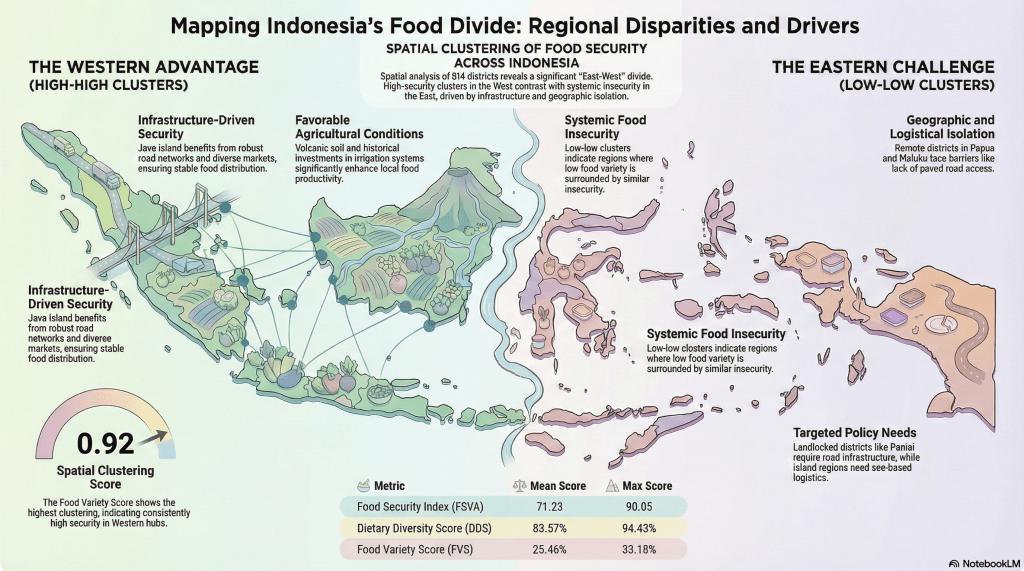
Here is the summary of the paper
A recent study reveals a sharp contrast in how different regions of Indonesia access food. The paper analysed data from 514 districts to understand the country’s food security status. The research uses advanced mapping techniques to show where people are well-fed and where they are struggling.
The study did not just look at one number. Instead, it used four different ways to measure food security. These included the official Food Security and Vulnerability Atlas (FSVA) and specific counts of calorie intake. The researcher also looked at “Food Variety” and “Dietary Diversity” scores. This approach provides a complete picture not just of how much people eat, but also of how nutritious their diet is.
A Tale of Two Regions. The maps highlight a clear divide between Western and Eastern Indonesia.
The Prosperous West. The island of Java is a “hotspot” for food security. The study calls these areas “High-High” clusters. Java benefits from fertile soil due to volcanic mountains and excellent infrastructure. Good roads make it easy to distribute food, and strong markets offer diverse products.
The Struggling East. Conversely, Eastern Indonesia faces major challenges. Regions like Papua and Maluku often fall into “Low-Low” clusters. These areas are geographically isolated. They often lack the ports and paved roads needed to bring in supplies. As a result, people there have less access to a variety of foods.
Hidden Pockets of Success. The study also found interesting exceptions. There are “High-Low” outliers, which are typically urban centres surrounded by struggling areas. For example, Merauke City in Papua has better food access than its neighbours. These examples show that improvement is possible even in difficult regions.
What Needs to Change?
The paper concludes that the government cannot use the same strategy for everyone. Different areas have different problems. For instance, the islands of Maluku need better sea transportation to improve logistics. Meanwhile, landlocked districts in Papua need new roads to connect them to markets. By tailoring policies to local needs, Indonesia can close the gap and help all citizens achieve zero hunger.
Here is the audiovisualisation of the paper.
 Regio Development
Leave a comment